

Kampong Thom - Home of Sambor Prei Kuk
"Kampong Pos Thom" was the original name of the present call Kampong Thom. Because originally long time ago, at the dock of Sen river next to a big natural lake, there was a big cave with a pair of big snakes inside. The people living around this area usually saw these big snakes every Buddhist Holiday. Time after that, the snakes disappeared, and the people of that area called Kampong Pos Thom.
Then, only short words Kampong Thom. During the French colony in Cambodia, the French ruled and divided Cambodian territory into provinces, and named them according the spoken words of the people called ‘Kampong Thom Province’ until now.
Kampong Thom is a province located at the central point of the Kingdom of Cambodia. The province has a total land area of 15,061km2 divided into 8 districts, 81 communes and 737 Villages. The total population is 576,805 people (110,334 families, women approximate 51%).
The province has road network which links from Phnom Penh to iem Reap on National Road 6, and separates to Preah Vihea province National Road 64 in a distance of 126 km.
Geography
The province is divided into two parts:
- Eastern part of National Road 6: Covers 70% surface consisting of forests and plateau, rich in natural resources which are good for agriculture, forestry and animal husbandry.
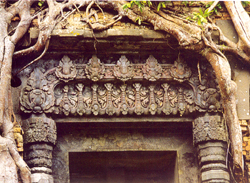
- Western of part of National Road 6: Covers 30% surface is the plain area extending to Tonle Sap Lake. This area is good for rice cultivation and fishing for supporting the needs of the province and exporting to other.
Kampong Thom is also a province-rich in tourism potentials to attract national and international tourists such as the exotic lakes, rivers, forests, mountain and more than 200 ancient temples.
History of Sambor Prei Kuk
The ancient city where monuments of Sambo Prei Kuk are found today was identified as ISANAPURA, the capital of Chenla in 7th century. Chenla was a former vassal of the Funan kingdom that was one of the first state in Southeast Asia, but it gradually gained its power and eventually King Citrasena Mahendravarman of Funan in the early 7th century.
Main archaeological features in these groups of monuments are said to have been founded by king ISANAVARMAN I, the son of king Citrasena.
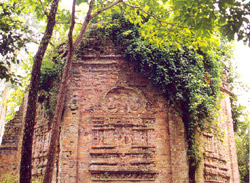
Many decorative details in Khmer architecture and sculpture are classified as Sambor style: the name was derived from these monuments dated in the first half of the 7th century. Henceforth this kingdom was the leading state and comprised the whole of Cambodia proper. Furthermore, several successions of kings’ reign might have maintained these monuments as their capital city. The century following the death of JAYAVARMAN I who is the last known king of this kingdom in the second half of the 7th century is a dark period in the history of Chenla. According to a Chinese accounts, in the 8th century, the country of Chenla was divided into land and water Chenlas. The obscurity prevails and this monument might be neglected thereafter. The history. However, is traced again with the accession of JAYAVARMAN II, who founded a new polity that is now referred as Angkor in the beginning of 9th century. Decorative details of Prasat Tao (Central Group) are similar to the style of the remains belong to the period of the king JAYAVARMAN II, Particularly, characteristic lion statues resembles the statues found in Phnom Penh. From these reasons this architectural complex is said to be constructed in this period.
Furthermore some inscriptions in Prasat Sambor (Northern Group) are dated in the 10th century under the reign of the king RAJENDRA VARMANII. And Robang Romeas group that is located about 2km northward from main temple area, contains other inscriptions of the king SURYAVARMAN I period. Some other decorative details and statues belong to the late Angkor period styles were confirmed from these temples. These historical evidences suggest that these monuments must have belonged to the important provincial principle city after Pre Angkor period.
From above historical perspective, this group of monuments is extremely significant not only for Cambodia but also for the entire area of Southeast Asia, for they are the only remaining sound architectural constructions that exemplify the architecture and sculpture of the early period in sizable quantity.
Sambor Prei Kuk Group
Sambor Prei Kuk cluttering sanctuaries were located in Sambor Village, Kampong Cheuteal Commune, Prasat Sambor District, Kampong Thom Provice. King Mahendravarman had reigned form 607 to 616, was a son of a king Sambor Prei Kuk style characterized the real khmer telent. After right received influence and developed her own arts sufficient to the modern development. Arts and civilization of Angkor was the great achievement in Southeast Asia. The well-known city was called Isanapura is presently located at Sambor Prei Kuk, Kampong Thom Province. Sambor Prei Kuk is 25km north of Provincial Town of Kampong Thom. By observation, there are 52 small and big sanctuaries are in fairly good condition, the other 52 sanctuaries were fallen down and buried into the ground, and then became small hills. The sanctuaries were built of brick and limestone with the decoration of bas-relief on the scenery walls. The foundation of sanctuary was made of laterite, false door, diamond column and the sculptures were made of sandstone.
Prasat Sambor Group (Northern Sanctuaries)
Northern sanctuary group comprised 11 sanctuaries separated from each other with the one at the middle, and had two-wall rampart. The sanctuaries were built of brick and limestone and carve in the beautifully real khmer style. These achievements certified the real khmer talent, after received the influence from India. Khmer had prepared her country and developed arts by herself. The every great development was in Angkor civilization period. The sanctuary was built on a rectangular hill (24m 21m or 25,200 square meters or 2.52 hectares).
The sanctuary comprised 14 temples (only 8 remains), and were surrounded by two-wall rampart. These temples were constructed in various plans-square and octagonal shapes. The top of the temple was carved in lotus petals of sandstone, but some parts were cracked down and buried into the ground and the pile of bricks.
Lion Temple Group
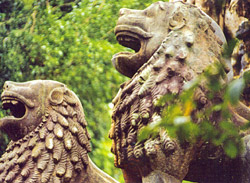
Lion temple group comprise 18 temples with two ramparts closed to the pond. The reasons why the people called Lion Temple because on the tops of all stairs from the four directions, there were sitting lions with forelegs standing up, hind-legs humbling down, its head rose up and its mouse opened to the sanctuary.
The rampart outside made of laterite, had 328-meter length, 310-meter width and 101,650-square-meter surface.
This rampart had Gopura in two-direction (East and West) entrances that are connected by the other laterite ramparts. In between rampart 2 and 1, at the Northeastern side near the rampart 1, there was a rectangular pond (42.10m x 34.20m). The bottom of the pond spread by laterite and surrounded by the stepped stairs. The small stairs of the Southern side are made of sandstone.
Now the pond is empty during the dry season. When we enter from the Eastern Gopura on either side of the road, we see two sanctuary hills were built on high terrace with the tracks of the round column made of laterite lining up in 0.40m height.
Prasat Yeai Poeun Group
Prasat Yeai Poeun Group comprised a total of 22 sanctuaries (5 have octagonal shapes) with two wall rampart, and was built of brick, masonry, laterite and sandstone in rectangular from in 7th century (600-635) during the reign of Isanavarman I to dedicated to Shiva. They were built on a hill with Gopura from the eastern and western entrances joining to an outside laterite rampart. The inner rampart reached by gateways from the four directions and joined to the brick rampart carved in various clustering figures.
Along the sanctuary contained the eastern and western Gopura joined to the laterite rampart (304m x 274m or 83,296 square-meter surface). Gopura contained framed door with diamond columns and a lintel built of sandstone. Eastern Gopura contained a buried large inscription (size: 2.41m x 0,9m x 0,15) inscribed with 17 lines of script. This inscription was brought to be kept in Kampong Thom Museum.
Kroul Romeas Group
Behind Kroul Romeas Group, there were four more sanctuaries made of brick and built during the reign King Suryavarman 1(end of 11th century). These sanctuaries were built on a rectangular hill, and faced to the East. One of sanctuaries was not completely built yet, it was likely built in later period. The lintel was carved in the form of bow without the modal. At the southeastern side, there were two temples recognized as the original ancient khmer styles.
Phnom Santuk
Since the ancient time to the present, Phnom Santuk Mountain has been called in many names as below:
- Phnom Thom (in history)
- Phnom Arth Santuk (In history)
- Phnom Chorm Chong Kiri
- Phnom Krop Tuk
- Phnom Preah Bat Chann Tuk
The ancient heritages on the top of the mountain
- Many Buddha statues were carved from great mountain rock including three big Buddha statues reaching Nirvana, each has more than 10-meter length.
- Prasat Touch of pyramid shape, made of sandstone, has three stories and three-meter height, and is located next to the ancient wooden temple (presently, it is made of cement) with a rectangular pond (10m x 4m).
- Preah Bat Chann Tuk statue was carved on the stone shaped as food of a sacred human, and there are many other small sculptures.
By the stories, the construction and the statues were erected during the reign of Preah Ponhea Dharma Reacha (1474-1494) and have been maintained until now.
Phnom Santuk has changed names to Chorn Chong Kiri and Phnom Krop Tuk. Chan Dare or Chan Chare are called two pieces of stone by local people that join all together in marked symbol and made in small hole, the passenger arrived there, they always dropped cash coins (ancient coins) into this small hole. When cash coins was dropped in, it make soft weak voice like a voice of the birds sing or music with happiness. So they did that since ancient period.
Preah Bat Chan Tuk or Buddha statue
- Was built by King Ang Chan I (16th century).
- King Baksei Chamkrong built a wooden temple on Phnom San Tuk at the same year.
- Sculptures carved on large ancient stone with many scenes of story.
- Buddha statue reaching Nirvanawas carved on larges-stone since 16th century.
Prey Pros
Prey Pros is a natural and cultural site located at Prey Pros Village, Prey Preal Commune, Kampong Svay District in approximate 16-km distance northwest of Provincial Town of Kampong. The site cover an area of 2 million square meters and includes a river (4,000-meter length and 30-meter width) which is rich in Domrei fish. The site is a venue for foot races, bicycle races, and other games during national festivals. In addition, the provincial tourists’ office has organized other recreational activities such as boating, fishing and swimming, and has built resting cottage where food and drinks are sold. The view from Prey Pros is beautiful and enchanting, while the wind which blows across the river will cool and refresh the hot and tired tourists.
Prasat Kuh Nokor
Prasat Kuh Nokor is located in Trodoc Poung Village, Pong Ror Commune, Baray District, Kampong Thom Province and is in the complex of Wat Kuh Nokor (Buddhist Pagoda). To reach there, passenger can take all kinds of vehicle on National Road 6, then turn west through the gate of Kuh Nokor pagoda in a distance of 2km. It is 79km from Provincial Town of Kampong Thom. These sanctuaries were built on the flat ground, on a square terrace made of laterite and sandstone facing to the East with the rampart surrounding. This rampart has a 35m-length (East to West) and a 25m-width (North to South). There is surrounding rampart of one meter height and 0.8 meter thick with two gateways: Eastern gateway is 9m height divided into 3 rooms, and western gateway is small and has square shape.
The structures of the buildings are mixed, made of laterite and the decoration of sandstone. East of the temple, there are 2 ponds-the small one has about one-meter depth,45-meter length and 20-meter width, and the big one has 160-meter length, 88-meter width and more than one-meter depth.
Prasat Kuh Nokor comprises
- The throne is square shape, made of sandstone and decorated by lotus flowers and pointed-diamond style, and has square hole at the middle.
- A male standing statue remains from thigh to shoulder.
- A male standing statue remains from thigh to the navel.
- A male coiling statue is difficult to be identified as the statue broke the end of the arm and the sole of the foot (local people called the statue ‘Neak Ta Bark Kor’.
Prasat Kuh Nokor was built in 10th -11th century by the king Suryavarman I (1002-1050). But in the same year (1002), another document said there was a king named Preah Bat Jayviravarman who who was also on throne (1002-1010). The two kings claimed that they were on throne at the same year, this leading to war between king and king until 1006. Then the king Suryavarman I conquered Yasodharpura city, however the war still lasted for 04 years to end. In 1010, the king Suryavarman I gained success over the entire territory and had full power in the country.
Prasat Kok Rokar (Preah Theat)
Prasat Kok Rokar is located in Rokar Phum, Srayov Commune, Stung Sen District, Kampong Thom province in a 14-km distance from Provincial Town of Kampong Thom. The temple was built of sandstone and laterite in Khleng style at the end of 11th century during the reign of king Suryavarman I to dedicate to Siva.
This isolated sanctuary (dimension: 6m x 5m; 8m height) was built on the hill and faced to the east. The body of the central temple has conical form with porches opening to the east, and a door reached from the eastern entrance (three other doors were the false doors). The diamond column has octagonal forms, and the three lintels have various forms. Based on the study to the site, the sanctuary was formed in rectangular shape. The outside rampart has 25m x 25m size and Gopura from the four directions which jointed to the surrounding laterite rampart. Outside the rampart, there were likely moats surrounded as we saw some marks remain until now. In observation to the temple’s court, there were lintels and inscriptions available at the surrounding. The lintels has various style some in Sambor Prei Kuk, some in Prei Khmeng and some in Kulen style etc. This didn’t mean that the artists built the mixed styles. According to the elderly resident there said that during the French colony in Cambodia, these ancient objects were brought from other temples to gather here in preparing to break into small parts that would then be used to pave the roads, but they didn’t construct the roads yet due to the war happened in the Country that why these ancient objects remained there.
On the hill 1km from the temple, where they held midnight ceremony every full moon day with making virgin girls dancing around the fired place to pray for the rain. This ceremony could be participated by virgin girls only.
Prasat Phum Prasat
Located in Prasat Village, Prasat Commune, Snatuk District, Kampong Thom Province. This temple located in a 27-km district from Provincial Town of Kampong Thom, and there is road from the southern direction of 500-meter length. This temple was built of brick, masonry and sandstone in 8th century (706) with Kampong Preah style to dedicate to Siva. It was a sanctuary built temple on the flat terrace without the false door and faced to the east. In the ancient period, the door were made by two wooden boards-one carved with sculptures of male divinities at another one carved with female divinities. The southern framed door was inscribed with five lines of inscription, and its back was mostly erode. The lintel was ornamented by the garlands; the diamond column we carved with carousing motifs; and the upper corner of the temple contained the segments of Linga and Yoni. Southeast of the temple, there were other two more temples (at present, they became the small hills). South of the large temple, were was a hill called Toul Samrong or Toul Nak Ta Samrong; and east of this hill, there was a Pou tree in which the local people call Toul Nak Ta Deum Pou (the hill of the body tree spirit). In ancient time, this place was the former royal palace where the royal valuable were kept. Then it was excavated and the valuables were taken away during the French colony. This sanctuary was in seriously ruined condition, in 1996 the brick of the southern and western towers dropped down due to the trees growing and the strong wind blowing on them. Besides, there was lack of conservation and protection leading to the serious damages caused by nature and aged existence at the sanctuary especially by the ignorant people.
Closed against the sanctuary, where the Buddhism monks constructed the new temple. This could caused the damages to the ancient sanctuary. Beside the Prasat Phum Prasat, there was an inscription buried into the ground which its upper part was inscribed with six lines of Sanskrit scripts. This inscription was found at six kilometers near the Police Post on National Road 6.
Prasat Andet Temple
Prasat Andet is located northwest of Provincial Town of Kampong Thom, in Prasat Village, Sankor Commune, Kampong Svay District, Kampong Thom Province. The temple was built in second half of 7thcentury (627-707) during the reign of king Jayavarman I to dedicate to God Hirihara, in Kampong Preah style and made of brick with masonry, laterite and sandstone. Prasat Andet had isolated plan, built on a 5.30-meter height artificial hill, and was form in rectangular shape with 7.50-meter length, 5.50-meter width and 1-meter thick (interior to exterior). It was facing to the East. The lintel of Prasat Andet was carved in the garlands and carefully done in the traditional khmer style.
The coronet (2.22 lengths) was ornamented around by the rings decorated, and at between of the rings we decorated with garland and bulb flowers surrounded, which are joining each other by the end of the decorations. In original former time, this temple contained Harihara Statue standing on a decorative royal throne, and the statue was brought to be kept at Phnom Penh National Museum. The Harihara statue is a body side’s Siva and another body side’s Vinu. The framed door had 1 m width, 2m height and 0.20m thick. On the northern framed door, we saw the marks of a cloven hoof of tiger cat that used to go to the upper box of the door, which remained the marks until now.
Bird Sanctuary of Boeng Tonle Chmar
Boeng Chmar contains fishing lot 5 and lot 6, and is 30km far from Stoung District town of Kampong Thom Province, there were villages of Nesat, Kamong Kdei, Svay Kor, Mo Doung, Kampong Bradom and Msa Trang Tboung in Peam Bang Commune. The people living in this area with floating houses that are moving up and down according to the water levels in the jungle and flooded forest. The bird sanctuary of Boeng Chmar covers a land area of 400 hectares having an interconnecting network of water channels along the bank of Boeng Kla Lake, rich in flooded forests. This area is connected by two big river tributaries (Stoung and Stung Chik Kreng) flowing down to Boeng Chmar. Beong Chmar is the sanctuary for many kinds of birds.
Stone Handicraft
Located at Ka Kos Village, Ka Kos Commune, Santhuk District in 16-km distance from Provincial Town of Kampong Thom on National Road 6. The craftsmen take the rocks from the Santhuk mountain’s foot to make statues and various figures for house decoration. This stone handicraft is served for domestically and internationally target markets. Beside stone handicraft, Kampong Thom has other handicraft like Krama, Silk shirts, traditional khmer clothing and handbags.
Read more about Kampong Thom Province
More Articles on What To See
Angkor Complex
Phnom Penh City
Sihanoukville - Beach
Mondulkiri - Minority
Rattanakiri - EcoTourism
Kampot - Sea Foods
Kratie - Dolphin
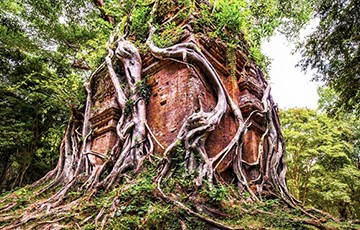
Kampong Thom
Battambang
Preah Vihear
Kirirom Resort
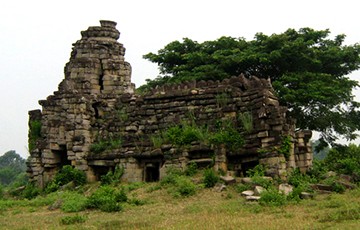
Banteay Chhmar Temple
Cambodia Tours
Cambodia Day Tours
Angkor Temple Tours
Cambodia Classic Tours
Promotion Tours
Adventure Tours
Cycling Tours
Trip Planner
Useful Links
Travel Services
News & Media

Agency offering information about Cambodia on tourism, culture, history, visa, attractions, province guides, trip planner, hotels, flights, cars, tours, news, photo and online bookings.
#262D, Monivong Blvd., Sangkat Beung Raing, Khan Daun Penh.Click here to contact us.