

Prasat Ta Prohm - The Ancestor Brahma, Jungle Temple
Ta Prohm's state of ruin is a state of beauty, which is investigated with delight and left with regret.
Ta Prohm is locating southwest of the East Mebon and east of Angkor Thom. Its outer enclosure is near the corner of Banteay Kdei. It can be accessed by enter the monument from the west and leave from the east entrance.

Tip: Ta Prohm is especially serene and beautiful in the early morning. A torch and a compass are useful for visiting this temple at all times. It was built about mid-12th century to early 13th century (1186) by the King Jayavarman VII, dedicated to the mother of the king (Buddhist) replica to Bayon style of art.
BACKGROUND
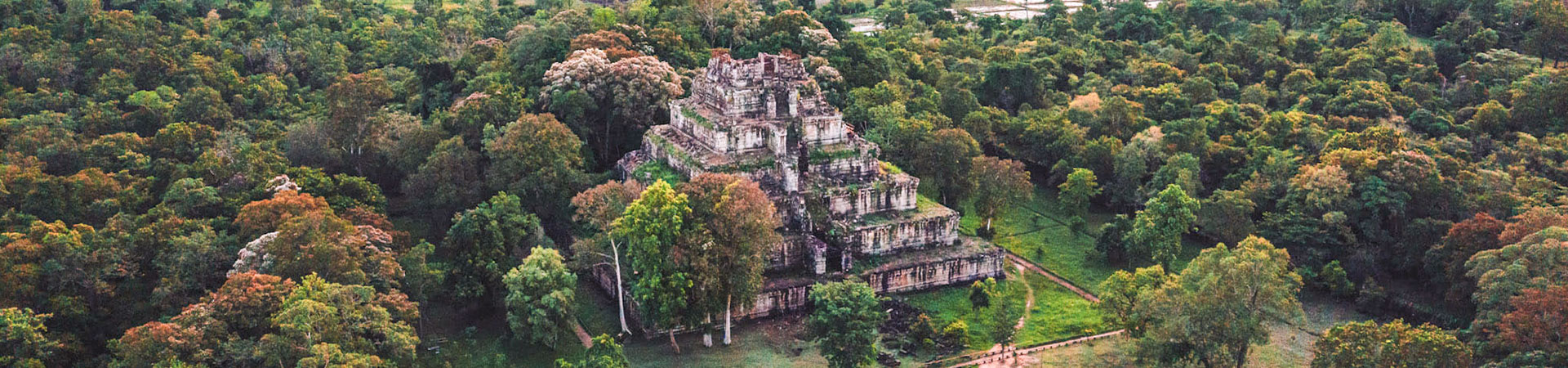
Ta Prohm is the undisputed capital of the kingdom of the Trees'. It has been left untouched by archaeologists except for the clearing of a path for visitors and structural strengthening to stave of further deterioration.
Because of its natural state, it is possible to experience at this temple the wonder of the early explorers when they came upon these monuments in the middle of the nineteenth century.
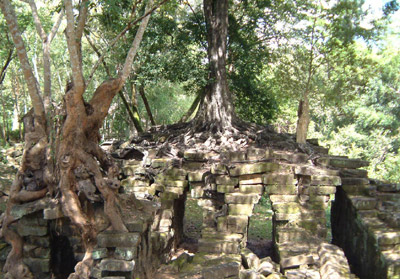
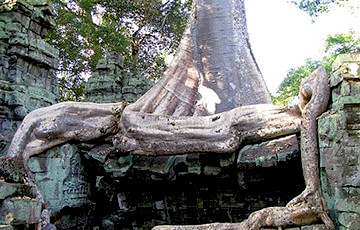
Shrouded in dense jungle the temple of Ta Prohm is ethereal in aspect and conjures up a romantic aura. Fig, banyan and kapok trees spread their gigantic roots over stones, probing walls and terraces apart, as their branches and leaves intertwine to form a roof over the structures. Trunks of trees twist amongst stone pillars. The strange, haunted charm of the place entwines itself about you as you go, as inescapably as the roots have wound themselves about the walls and towers', wrote a visitor 40 years ago.
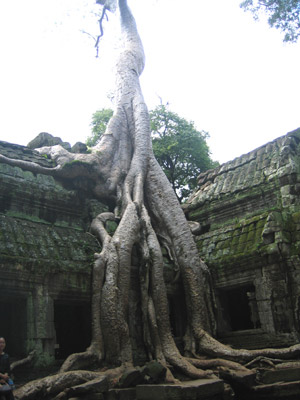
Root of Banyan Tree on the Ta Prohm Temple
A Sanskrit inscription on stone, still in place, give details of the temple. Ta Prohm 3,140 villages. It took 79,365 people to maintain the temple including 18 great priests, 2,740 officials, 2,202 assistants and 615 dancers. Among the property belonging to the temple was a set of golden dishes weighing more than 500 kilograms, 35 diamonds, 40,620 pearls, 4,540 precious stones, 876 veils from China, 512 silk beds and 523 parasols. Even considering that these numbers were probably exaggerated to glorify the king, Ta Prohm must have been an important and impressive monument.
LAYOUT
Ta Prohm is among the largest of the monuments in the Angkor complex, the in scrimption gives an idea of the size of the temple. The complex included 260 statues of gods, 39 towers with pinnacles and 566 groups of residences. Ta Prohm comprises a series of long low buildings standing on one level, which are enclosed by rectangular laterite wall (600 by 1,000 meters, 1,959 by 3,281 feet). Only traces of the wall are still visible. The center of the monument is reached by a series of towers connected with passages. This arrangement forms a ' sort of sacred way into the heart of the monument’; three-square galleries enclose the area.
Tip: Some areas of the temple are impassable and others are accessible only by narrow dark passages. It is recommended to follow the plan with a route and landmarks indicted or to stay with a guide to avoid getting lost.
The boundaries of the exterior wall are recognizable on the west by a stone entry tower in the shape of a cross, with an upper portion in the form of four faces, one looking towards each of the cardinal points (not shown on the plan). The approach to the west entrance of the temple is a path through the forest. After about 350 meters (1,148 feet) there is a stone terrace in the shape of a cross. Remains of lions, serpent balustrades and mythical creatures lie scattered in the area. Walk across the terrace to the vestibule of the enclosing wall. The view from this point is spectacular.
Every here around you, you see nature n this dual role of destroyer and consoler; strangling on the one hand, and healing on the other; no sooner splitting the carved stones asunder than she dresses their wounds with cool, velvety mosses, and binds them with her most delicate tendrils; a conflict of moods so contradictory and feminine as to prove once more if proof were needed how well " Dame "Nature merits her feminine title.
The next causeway with serpent balustrades on each side leads to an entry tower in the first enclosure around the temple. Inside, on the right, niches along the inner wall contain images of the Buddha.
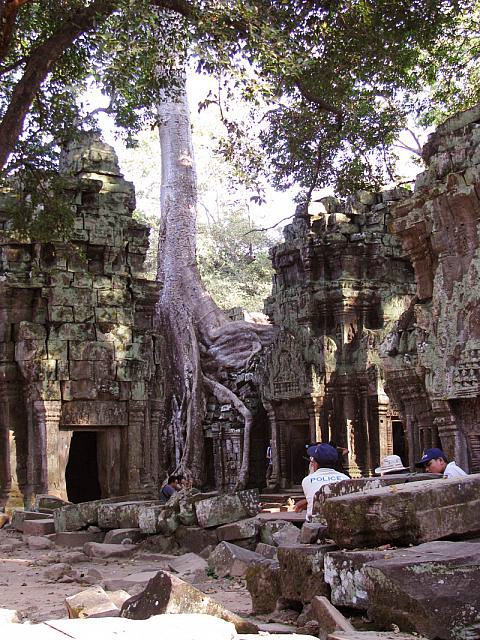
Return to the center of the vestibule, turn right and walk through the courtyard to the annex building at the right. Continue walking straight through the series of rooms and passages to a tower. The relief on the horizontal beam is a fine representation of a scene from 'The Great Departure ' when the future. Buddha decides to leave his father's palace to live the life of a monk, the gods hold the hoofs of his horse so those sleeping in the palace are not awakened. Return to the courtyard and pass through an opening as opening in the wall of the second enclosure (at the south end).
The roots of a tree grip the double row of pillars in this gallery. Walk to the center of the complex, turn right and enter the entry tower of the third enclosing gallery. The inner walls are decorated with friezes of pendants, scrolls and figures in niches. Turn right again and walk into the central courtyard of the temple.
CENTRAL SANCTUARY
Follow the plan and walk through the Central Sanctuary, recognizable by its undecorated interior. The stone has hammered, presumably to apply a coating probably of paint or gilt. Evenly spaced ' holes in the wall from floor to ceiling suggest a covering of wood, stucco or metal.
Walk across the central courtyard towards the left (northeast) and through the door of a gallery that is framed by the roots of a tree. Turn left and walk through a dark passageway and a courtyard. Enter the aisle with pillars, turn right, walk straight between twin towers and to the right into a very narrow passage which houses the inscription of the temple. Return by the same passage, turn right and continue straight, passing through a vestibule. The false doors on the north and south sides of the large rectangular enclosure with high walls are finely decorated. There are four small courts with galleries and pillars (12). Ritual dances may have been performed in this area.
Walk across the courtyard and into the entry tower of the enclosing wall, at the east entrance. It is in the shape of a cross with pillars on the interior, four wings and two passages on the side. The walls of these passages are decorated with relief. To the left there is a hall with pillars placed close together. They probably provided the base for a structure built of wood. Beyond are small rectangular cells, which surround the exterior of Ta Prohm.
One leaves Ta Prohm by a path (400 meters, 1,32 feet long) leading to the exterior enclosure where section of the wall are visible.
So the temple is held in a stranglehold of trees. Stone and wood clasp each other in grim hostility; yet all is silent and still, without any visible movement to indicate their struggle as if they were wrestlers suddenly petrified, struck motionless in the middle of a fight, the rounds in this battle were not measured by minutes, but by centuries.
Related Articles...
Angkor Wat
Ak Yum
Angkor Thom
Bakheng Mountain
Bakong
Baksei Chamkrong
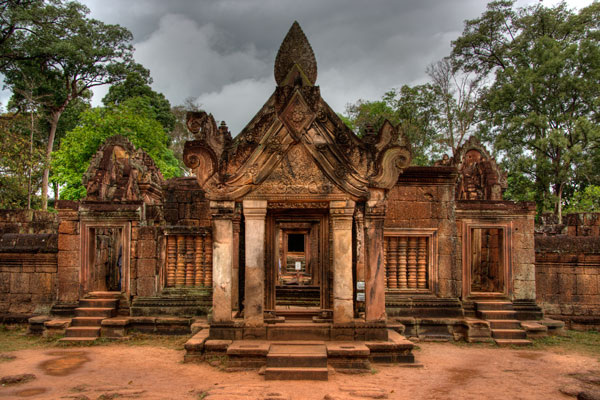
Banteay Srei
Banteay Kdei
Banteay Samre
Baphuon
Bayon Temple
Beng Mealea
Chau Say Tevoda
East Mebon
Kravan
Krol Ko
Lo Lei
Neak Pean
Phimean Akas
Phnom Krom
Pre Rub
Preah Khan
Preah Ko
Preah Palilay
Preah Pithu
Roluos Group
Sour Prat
Spean Thmar
Srah Srang
Ta Keo
Ta Prohm - Jungle Temple
Ta Som
Tep Pranam
Terrace of Elephants
Terrace of Leper King
Thommanon
West Baray
West Mebon
Chapel of the Hospital
Kbal Spean
Phnom Kulen
More Articles on What To See
Angkor Complex
Phnom Penh City
Sihanoukville - Beach
Mondulkiri - Minority
Rattanakiri - EcoTourism
Kampot - Sea Foods
Kratie - Dolphin
Kampong Thom
Battambang
Preah Vihear
Kirirom Resort
Banteay Chhmar Temple
Cambodia Tours

Cambodia Day Tours
Angkor Temple Tours
Cambodia Classic Tours

Promotion Tours
Adventure Tours

Cycling Tours
Trip Planner
Useful Links
Travel Services
News & Media

Agency offering information about Cambodia on tourism, culture, history, visa, attractions, province guides, trip planner, hotels, flights, cars, tours, news, photo and online bookings.
#262D, Monivong Blvd., Sangkat Beung Raing, Khan Daun Penh.Click here to contact us.