


Partnerships for a healthier sector
16 May 2018
Singapore
One-stop services rule it all
When it comes to patient comfort and hospitality, several Singapore hotels have gotten that down to a tee, offerings suites and amenities that cater to guests seeking medical services in hospitals nearby.
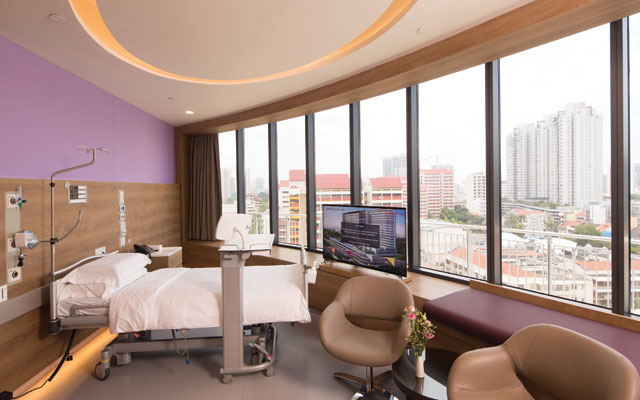
Most of these hotels are clustered in Novena and Farrer Park, the seats of major medical campuses including Mount Elizabeth Novena Hospital, KK Women’s and Children’s Hospital and Farrer Park Hospital.
One Farrer Hotel & Spa, for example, introduced The Farrer Suites – the first of its kind in Singapore – to cater to patients of Farrer Park Hospital and Farrer Park Medical Centre in the same building.
These self-contained suites are equipped with features such as adjustable Volker beds with pressure-relieving mattresses, a built-in counter for hand washing, a companion bed and dedicated butler service. The suites are accessible through a private lift system connected directly to the medical wings of the building, and are sold only through the hospital.
Meanwhile, Park Hotel Farrer Park is awaiting the opening of Farrer Square Medical Centre, which will connect 42 medical units to the hotel and Farrer Park Hospital.
Courtyard by Marriott Singapore Novena, which offers two mobility-accessible rooms and six elderly-friendly rooms, does not limit its connections to just Mount Elizabeth Novena Hospital next door, but also works with Tan Tock Seng Hospital and KK Women’s and Children’s Hospital on various fronts.
Peter Khong, general manager of Courtyard by Marriott Singapore Novena, shared that the hospitals not only refer international patients looking for external accommodation options, but also overseas doctors and consultants.
While Indonesia is an enduring source market for medical guests, One Farrer Hotel & Spa’s executive assistant manager, sales & marketing and rooms, Jessie Khoo-Gan, also noted rising demand from China, Vietnam, Thailand and India.
She added: “There has been an increase in medical travellers seeking preventive healthcare services and wellness; and we see a greater demand for premium luxury accommodation and services to complete their patient experience.”
Hotels also extend other areas of their hospitality services to warded patients. One Farrer Hotel & Spa shares its kitchen with the adjoining Farrer Park Hospital, providing five-star cuisine for the hospital; while Park Hotel Farrer Park provides a breakfast package for Farrer Park Hospital’s health screening patients.
Park Hotel Farrer Park’s general manager Sharmini Moganasundram is certain that hotels can continue to grow and benefit from Singapore’s established position as “the premier medical destination in the region”.
Khong concurred: “We are always open to exploring opportunities with our partners to offer additional value-added services.” – Pamela Chow
Malaysia
Joint bid for Indonesians
With Indonesia accounting for 60 per cent of medical tourists to Malaysia, it’s no surprise that hotels located near major hospitals in Penang have their sights set on tapping this key South-east Asian source market too.
Glow Penang, which lies within walking distance to Loh Guan Lye Specialists Centre as well as a short drive to Island Hospital and Gleneagles Penang, already has strategies laid out with these private healthcare institutions in the pursuit of medical tourists from Indonesia.
Glow Penang’s hotel manager, Navintheran Sinarimuthu, said: “Most guests who stay with us and seek treatment from these hospitals are from Indonesia. They come here for health screening, dental, cosmetic procedures, eye and skin treatments.
“We promote our hotel directly to outbound agents in Indonesia who are involved in leisure and medical tourism as well as to the three (aforementioned) medical facilities in Penang. We provide special room rates with breakfast for the agents we work with,” he said.
Special brochures offering information about Glow Penang’s location and facilities are provided to agent partners as well as the reception areas of partner hospitals too, according to Navintheran.
The 320-key Berjaya Penang Hotel, likewise, takes advantage of its location opposite Penang Adventist Hospital as well as its easy access to other private hospitals in George Town area to attract medical tourists from Indonesia.
Amran Taib, executive assistant manager, Berjaya Penang Hotel, said: “We give corporate rates to the hospitals and also do joint promotions with them when we participate in medical fairs in Indonesia. We also promote the private hospitals in Penang by displaying their brochures in our hotel.”
He added: “We focus on cities that have direct flights to Penang as well as places without direct flights such as Balikpapan, Palembang and Jambi, where many medical tourists staying with us are from.
“Tourism authorities should further tap regional markets for medical tourism as these are our closest neighbours, and not just limit efforts to cities with direct air links to Penang,” Amran urged. – S Puvaneswary
Thailand
Natural advantage
In Thailand, where medical tourism is a growth industry, it makes natural sense for hotels located in the vicinity of major private hospitals to target the international clientele that these institutions are serving.
Medical centres are hence increasingly embracing hospitality concepts alongside a rising number of hotel-hospital partnerships, observed Olivier Berrivin, managing director of international operations – Asia at Best Western Hotels & Resorts.
He remarked: “In addition, global economic pressures on hospitals and patients, combined with broader medical tourism trends, are creating a growing niche for hotels located on or near hospitals. This particular segment will only grow over time as some countries are now offering medical visas to encourage that trend.”
Medical tourists already make up a significant market for Best Western Premier Sukhumvit Soi 1 and SureStay Plus Sukhumvit Soi 2, thanks to their close proximity to Bumrungrad Hospital and its strongly established international reputation, according to Berrivin.
Amari Residences Bangkok, located within walking distance to the Bangkok Hospital, meanwhile, has “a collaborative working relationship” with the hospital as an affiliated hotel, providing additional services and support to guests requiring extra care and attention in consultation with the medical teams or accommodate patients who prefer to reside in a comfortable environment off the hospital premises, Onyx Hospitality Group’s senior vice president commercial, Debrah Pascoe, told TTG Asia.
While the Middle East is a dominant source market of medical tourists, the inbound medical tourism source market for Onyx is “gradually being balanced by medical tourism demand from other regional markets like Japan and South-east Asian countries”, Pascoe noted.
Down south in Phuket, Amatara Wellness Resort has already seized opportunities in Thailand’s thriving healthcare tourism sector by linking arms with prominent Thai travel players to offer integrative wellness programmes.
Last year, it rolled out a brain health enhancement retreat with Bangkok Hospital Phuket to promote brain health in the prevention of Alzheimer’s disease and dementia. In February this year, it entered into an MoU with Royal Orchid Holidays and Vitallife Wellness Center, a subsidiary at Bumrungrad International Hospital, to tap the increasing level of interest in health and wellbeing among travellers worldwide.
Other hospitality players like Thanyapura Phuket, which was previously focused on the sports tourism market, is now enhancing its on-site healthcare offerings to step up its pursuit of Thailand’s flourishing medical tourism sector. It recently appointed Edgar Toral, a 15-year veteran in Thailand’s medical tourism sector, to head the Thanyapura Integrative Healthcare wing, and has in place treatments and services ranging from chiropractic and acupuncture to post-surgical care and and vitality therapies.
“We are not competing against hospitals but complementing them,” said Toral. More complicated treatments will be referred to Thanyapura’s partner hospitals in Phuket, he added. – Xinyi Liang-Pholsena
South Korea
Not just skin-deep interest
South Korea is well-known in the Asia-Pacific region as the place to go for everything from a quick nose tweak to procedures that are far more delicate. And many hotels are coordinating with hospitals and clinics to provide packages that meet guests’ needs throughout their visits.
The majority of overseas medical tourists to South Korea are from China, Russia, Japan, the US and Kazakhstan. Arrivals from Thailand in 2016 soared by an impressive 102 per cent, while the number of medical tourists from Mongolia, the UAE, Singapore and Vietnam also showed positive growth.
“We already have a selection of medical packages that we have developed in conjunction with the nearby Yonsei Severance Hospital,” said Jay Kim, sales manager for the Hotel Cappuccino. “Virtually all the guests staying with us for medical procedures are from Asia, including from Hong Kong and Singapore, and we are able to create tailor-made packages that meet guests’ needs and the requirements of the hospital.”
Sponsored News
More World Travel News
Cambodia Tours

Cambodia Day Tours

Angkor Temple Tours
Cambodia Classic Tours

Promotion Tours
Adventure Tours

Cycling Tours
Trip Planner
Useful Links
Travel Services
News & Media

Agency offering information about Cambodia on tourism, culture, history, visa, attractions, province guides, trip planner, hotels, flights, cars, tours, news, photo and online bookings.
#262D, Monivong Blvd., Sangkat Beung Raing, Khan Daun Penh.Click here to contact us.